Industrial Floors
Industrial & Warehouse Floors
Slabs placed flat, joints that hold up to forklifts, finishes that last.
In short
What is industrial floors?
Construction and repair of industrial floors covers new slab placement, joint and crack repair, grinding, polishing and resinous coatings for warehouses, plants and distribution space. A facility needs it when joint edges break under forklift wheels, the surface dusts or pits, cracks widen, a coating peels, or a new use demands a flatter, harder or chemical-resistant floor.
Industrial Floors
A warehouse floor is a working surface. We place new slabs, repair the joints and cracks that damage equipment, and grind, polish or coat existing floors so they stay clean, flat and easy to maintain under traffic.
Unified GCS has spent 45 years in this business. We carry out industrial floors projects across Broward and Palm Beach counties for condominium associations, property managers, commercial owners and industrial operators.
Written and reviewed by the Unified GCS project team, 45 years in concrete restoration and construction. Last reviewed October 2026.
Why it happens
Why warehouse slabs fail at the joints first
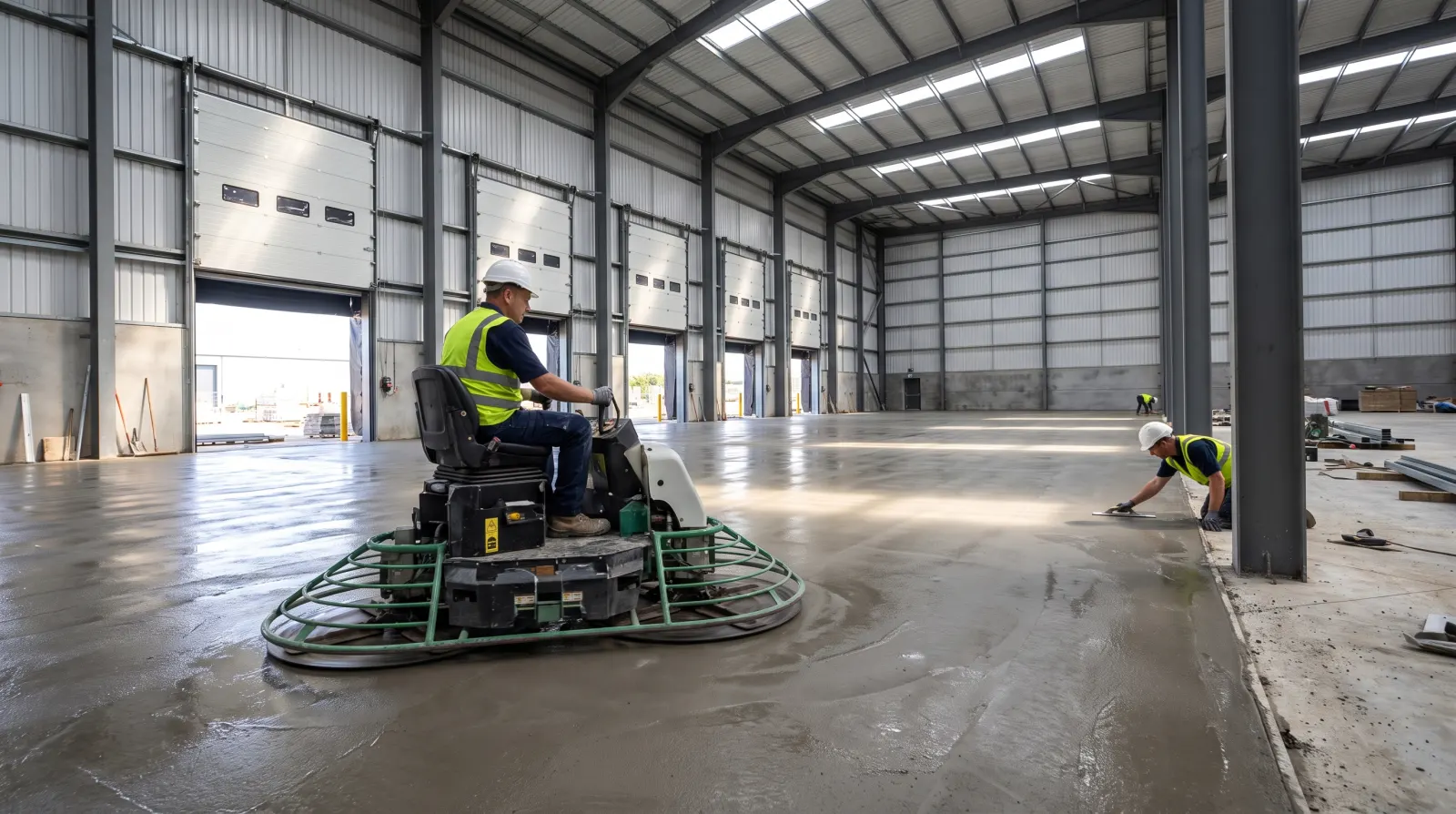
A slab on grade shrinks as it dries, so it is cut into panels with control joints that tell it where to crack. Those joints are the weak line in the floor. Hard forklift wheels strike the unsupported edges thousands of times a day, and once a joint filler has split or sunk, the edges chip and the joint widens. Panels also curl upward at their edges as the top dries faster than the bottom, which leaves the edge unsupported and rocking under load.
The surface wears in its own way. A floor that was finished or cured poorly has a weak top layer that dusts under traffic, and the fine powder gets into product and equipment. Random cracks appear where the subgrade settled, where joints were cut late or spaced too far apart, or where loads exceed what the slab was designed for. Oils and chemicals soak into unsealed concrete, and coatings applied over a damp slab blister and peel.
What is included
Industrial Floors: scope of work
- 01New slab-on-grade placement and finishing
- 02Joint repair, filling and rebuilding
- 03Crack and spall repair
- 04Concrete grinding, polishing and densifying
- 05Epoxy and urethane floor coatings
- 06Loading dock, ramp and equipment pad repairs
How we do it
How slabs are placed, repaired and finished
A new slab starts with the subgrade, compacted and graded evenly so the slab has uniform support, with a vapor retarder where the floor will receive a coating or covering. Reinforcement and dowels at construction joints are set as the design shows. The pour is struck off with a laser screed or to set forms, floated and power troweled to the specified flatness, cured, and sawcut at the designed spacing as soon as the concrete can take the blade without raveling.
Joint repair begins by cleaning the joint with a saw to the depth the filler manufacturer requires, removing old filler and debris. A semi-rigid joint filler, typically a polyurea or epoxy, is installed, overfilled and shaved flush so it supports the edges under wheels. Spalled edges are sawcut back square and rebuilt with a repair mortar before the joint is recut. Cracks are routed and filled the same way, and rocking panels are stabilized as the engineer directs.
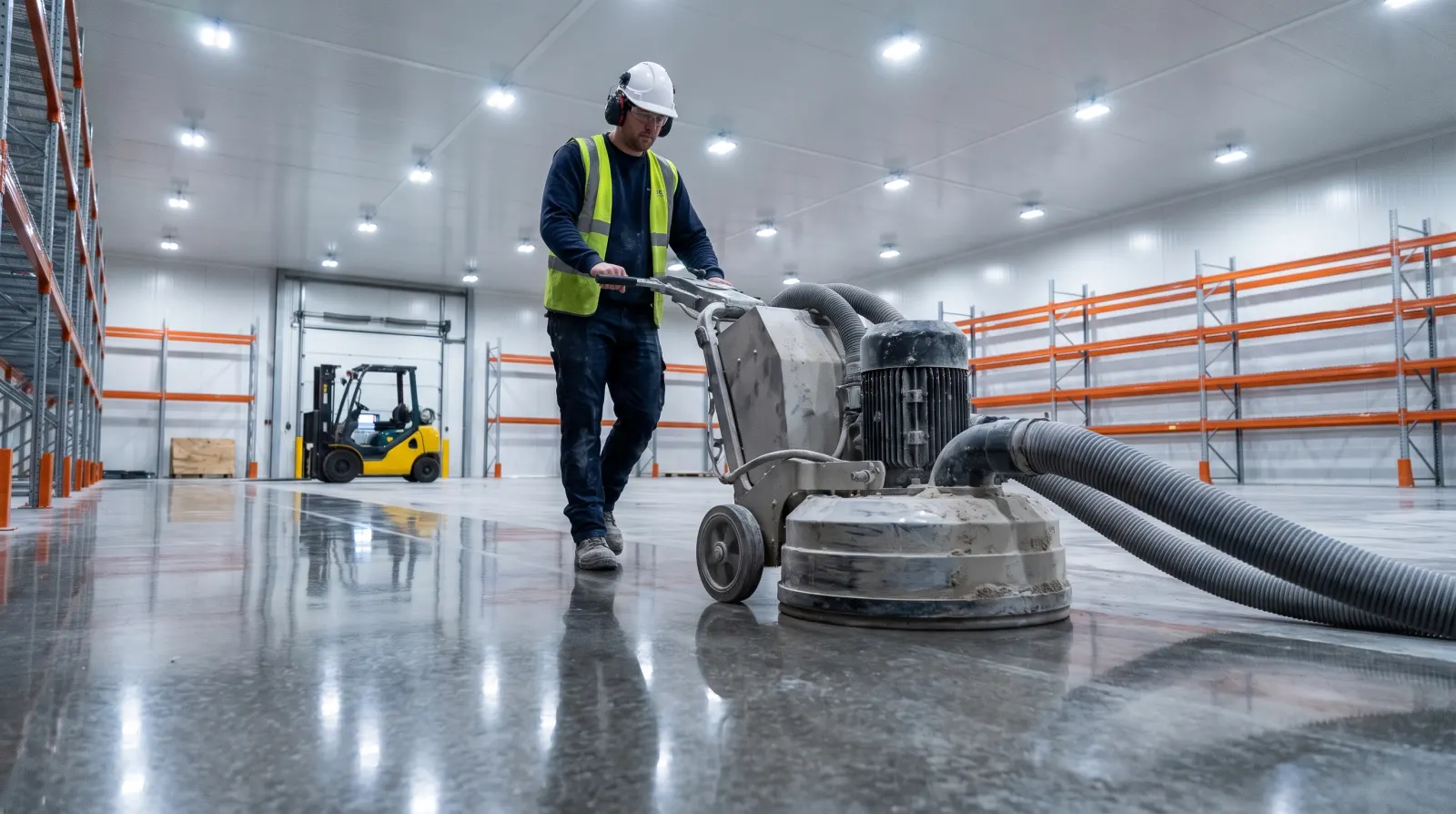
For a polished floor, the surface is ground with progressively finer diamond tooling, a liquid densifier is applied to harden the surface, and polishing continues to the gloss level chosen. For a coated floor, the slab is shot blasted or ground to the profile the manufacturer requires and tested for moisture before primer, body coat and topcoat are applied. Either way, cure time before forklift traffic follows the product data sheet, and areas reopen zone by zone.
Materials and systems
Epoxy, urethane, polished concrete and joint fillers: matching the floor to its use
Resinous floor coatings are selected by what the floor has to resist. Epoxy is the workhorse: hard, well bonded and available from thin sealers to trowel-applied mortars, but it yellows in sunlight and softens under heat. Aliphatic urethane topcoats add abrasion, ultraviolet and chemical resistance over an epoxy base. Urethane cement, a blend of urethane resin and cement, tolerates thermal shock and moisture, which suits food processing and wash-down areas. Polyaspartic and MMA systems cure in hours for facilities that cannot stop for long.
Polished concrete uses no film at all. A lithium or sodium silicate densifier reacts with the cement paste to harden the surface. Joint fillers are semi-rigid epoxy or polyurea, chosen for a hardness that supports wheel loads; polyurea sets faster and can be installed in cold storage. New slabs may use dry-shake hardeners, steel or synthetic fibers, and dowel baskets or plate dowels at joints. The floor designer or engineer sets flatness, thickness and reinforcement for the equipment in use.
What makes it last
What makes a warehouse floor repair or coating last
Coatings on warehouse slabs fail from below more often than from above. Moisture vapor rising through a slab without a vapor retarder can blister an impermeable coating, so moisture testing comes before product selection, and a moisture-mitigating primer may be required. Surface profile is the second factor: resin needs concrete opened by shot blasting or grinding, not acid washing. For joints, lasting work means filling to full depth after the slab has done most of its shrinking, and rebuilding spalled edges before filler goes in.
A proposal for industrial floors should state the moisture test method and results, the surface profile to be achieved, the system thickness, and the time before foot, forklift and full traffic are allowed. Ask how dust is controlled, and whether a test area will be installed first. During the work, check that joint filler is shaved flush, that coating thickness is verified, and that cure times are respected. Product warranties are issued by the manufacturer on its own conditions.
How a project runs
Planned around the people who use the building.
- 01
Walk the property
We start on site with your manager, board or engineer and look at the conditions first-hand.
- 02
Define the scope
You get a written scope tied to the engineer's report or our findings, with the phasing spelled out.
- 03
Plan access and safety
Swing stages, shoring, barricades, parking and resident notices are set before the first cut.
- 04
Do the work
Our crews carry out the repairs in sequence, with inspections at the points the engineer requires.
- 05
Close it out
Final inspections, permit closure and a record of what was done, for the association's files.
Summary
Industrial Floors: key takeaways
- 01
Moisture testing comes before choosing a floor coating, because vapor rising through a slab blisters impermeable resin systems.
- 02
Epoxy provides hardness and bond, urethane topcoats add abrasion and chemical resistance, and urethane cement handles heat and wash-down.
- 03
Polished concrete has no film to peel and relies on a silicate densifier to harden the slab surface.
- 04
Semi-rigid epoxy or polyurea joint filler supports slab edges under hard forklift wheels, which soft sealant cannot do.
Glossary
Terms you will see in the engineer's report
- Densifier
- A liquid silicate applied to concrete that reacts with the cement paste to form a harder, less dusty surface.
- Control joint
- A sawcut made in a new slab to create a weakened line, so that shrinkage cracking occurs neatly beneath the cut instead of randomly across the floor.
- Curling
- The upward lift of slab edges and corners that occurs when the top of a slab dries and shrinks faster than the bottom, leaving the edge unsupported.
- Concrete surface profile
- A standard scale describing how rough a prepared concrete surface is. Coating manufacturers state the profile their product needs in order to bond properly.
- Floor flatness
- A measured value describing how smooth and even a slab is over short distances. Narrow-aisle lift trucks and high racking need flatter floors than general storage.
Questions
Industrial Floors: common questions
Can you work while the facility stays in operation?
Yes. We section the floor and work nights, weekends or by zone so operations continue. Cure times and return-to-traffic windows are planned with your team up front.
Should a warehouse floor be polished or coated?
Polished concrete suits dry storage and distribution space: it is hard, low in dust, easy to clean and has no film to peel. A resinous coating is the better choice where the floor needs chemical resistance, a sealed surface for food or wash-down areas, or safety markings and color. The use of each zone decides it.
Why should floor joints be filled rather than left open?
An open joint leaves two unsupported concrete edges for every wheel to strike. A semi-rigid filler carries the wheel across and protects those edges, while still allowing a small amount of slab movement. It also keeps debris out of the joint. Soft caulking does not do this job under forklift traffic.
How long before forklifts can drive on a newly coated floor?
Return-to-service time depends on the resin. Fast-curing polyaspartic and MMA systems can take traffic within hours, while many epoxies need a day or more for foot traffic and several days for forklifts and chemical exposure. Temperature changes these times significantly. The product data sheet gives the figures, and we plan each zone around them.
Can a cracked warehouse slab be repaired, or does it need to be replaced?
Most cracked slabs can be repaired. Stable cracks are routed and filled with a semi-rigid material, and spalled edges are rebuilt. Panels that rock, have settled or have broken into several pieces usually indicate a problem with the support underneath, and those are stabilized or removed and replaced on a recompacted base. An engineer should assess slabs carrying racking.
Can residents stay in the building during restoration?
In most projects, yes. Work is phased by elevation or stack, balconies are closed only while they are under repair, and notices go out before anything affects residents. We agree the sequence and access plan with the board and manager before work starts.
Do you work with our engineer?
Yes. Structural repairs are built to the specification of your engineer of record, and we coordinate inspections with them throughout the job. If you do not have an engineer yet, we can help you get started.
Standards and references
- International Concrete Repair Institute (ICRI): concrete repair guidelines
- American Concrete Institute (ACI): codes and guides for concrete construction and repair
- Florida Building Code
Repair methods and materials on every project follow the engineer's specification, the manufacturer's requirements and the building code in force. This page is general information, not engineering advice.
Related services
 Milestone & Recertification
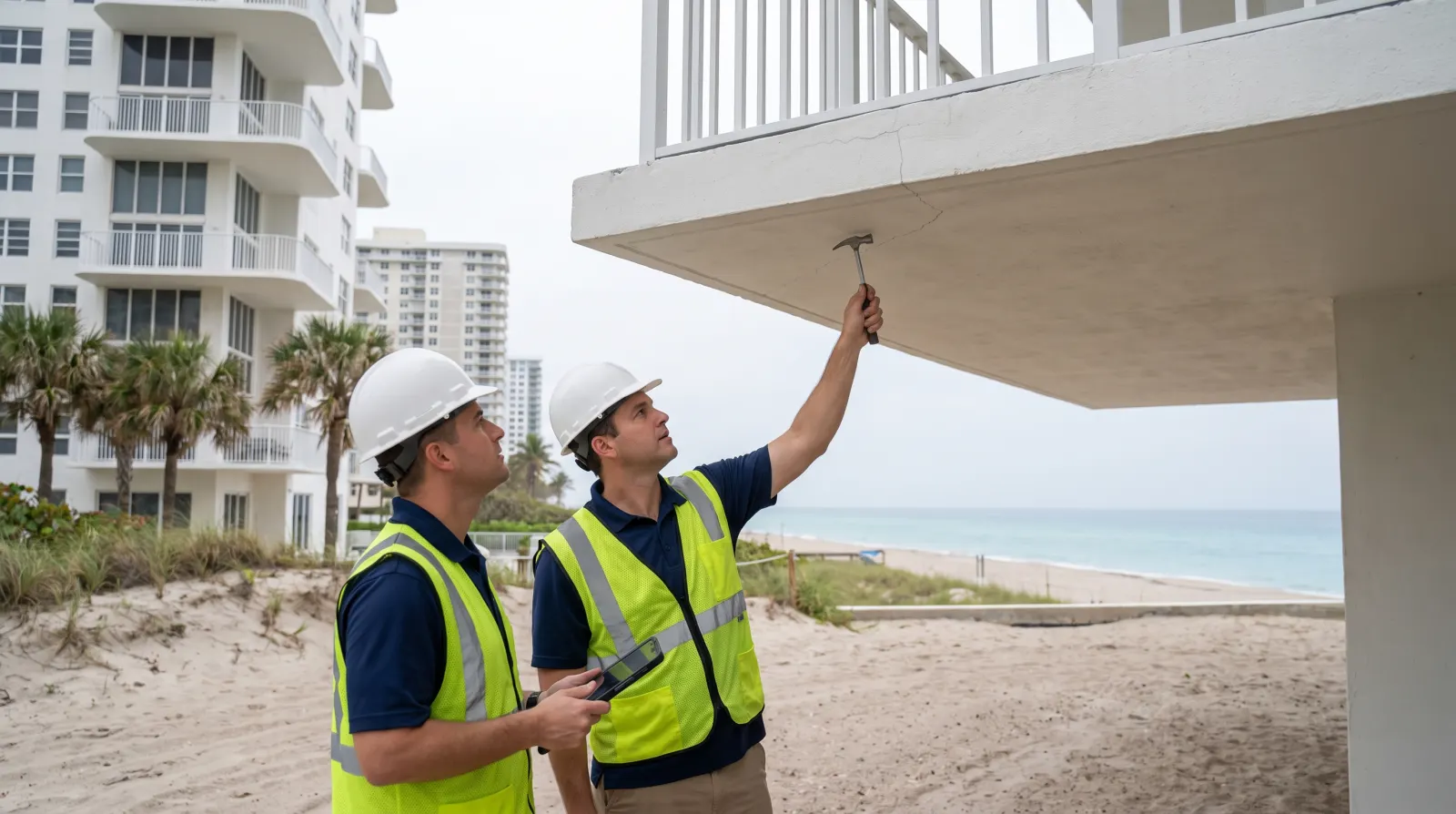
From the engineer's report to a closed permit, on a schedule your board can plan around.
 Concrete Restoration
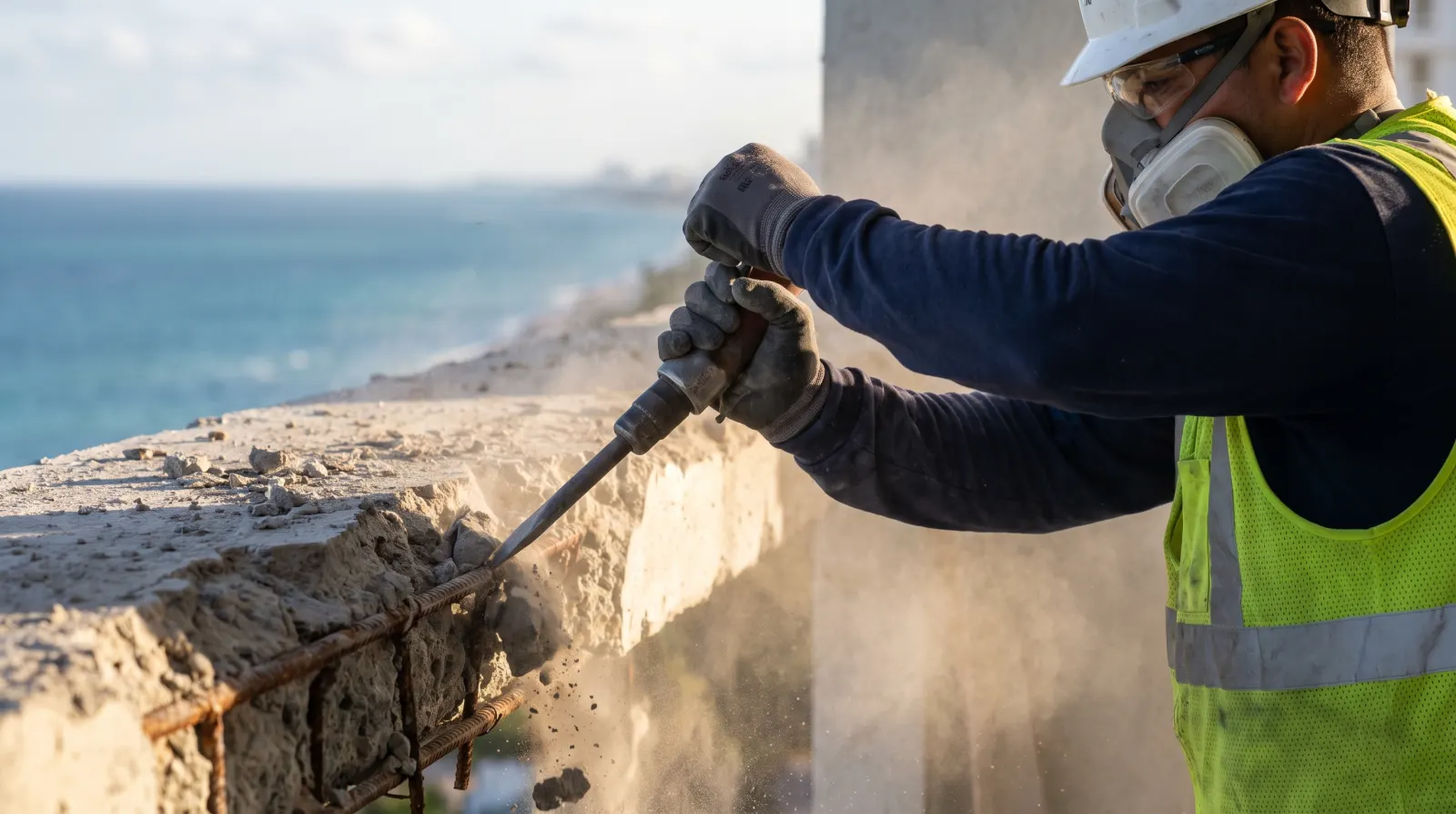
Spalling, cracking and corroded rebar, repaired to the engineer's specification.
 Waterproofing
Find where the water gets in, then close the building envelope for good.
Referred by an engineer?
Have drawings, specifications or a full set of bid documents?
Most of our restoration, pool and roofing work comes to us through structural engineers, property engineers and board members. When the scope is already drawn and specified, we price exactly what is on the documents, flag anything that needs a question, and show every line so the board can compare bids fairly.
Request an estimate
Let's look at your building.
Send us the engineer's report, a few photos or a short description. We will schedule a site visit and follow up with a written scope.
- 45 years in the business
- Broward and Palm Beach counties
- Reply within one business day
Prefer to talk?(561) 678-4182
We reply within one business day. Your details are only used to respond to this request.