Parking Garage Restoration
Parking Garage & Plaza Deck Restoration
Structural repair and traffic coatings for decks that carry cars, people and water.
In short
What is parking garage restoration?
Parking garage restoration is the repair of the slabs, beams, columns and joints of a parking structure, followed by a traffic-rated protective system on the deck. A garage needs it when an engineer finds delaminated or spalling concrete, exposed reinforcing, leaking expansion joints or a worn-through deck coating, all of which let salt-laden water reach the steel.
Parking Garages & Plaza Decks
Garages and plaza decks leak from the top and corrode from within. We repair slabs, beams, columns and joints, then protect the structure with traffic-rated waterproofing so the damage does not come back through the same path.
Unified GCS has spent 45 years in this business. We carry out parking garage restoration projects across Broward and Palm Beach counties for condominium associations, property managers, commercial owners and industrial operators.
Written and reviewed by the Unified GCS project team, 45 years in concrete restoration and construction. Last reviewed October 2026.
Why it happens
Why garages and plaza decks corrode from within
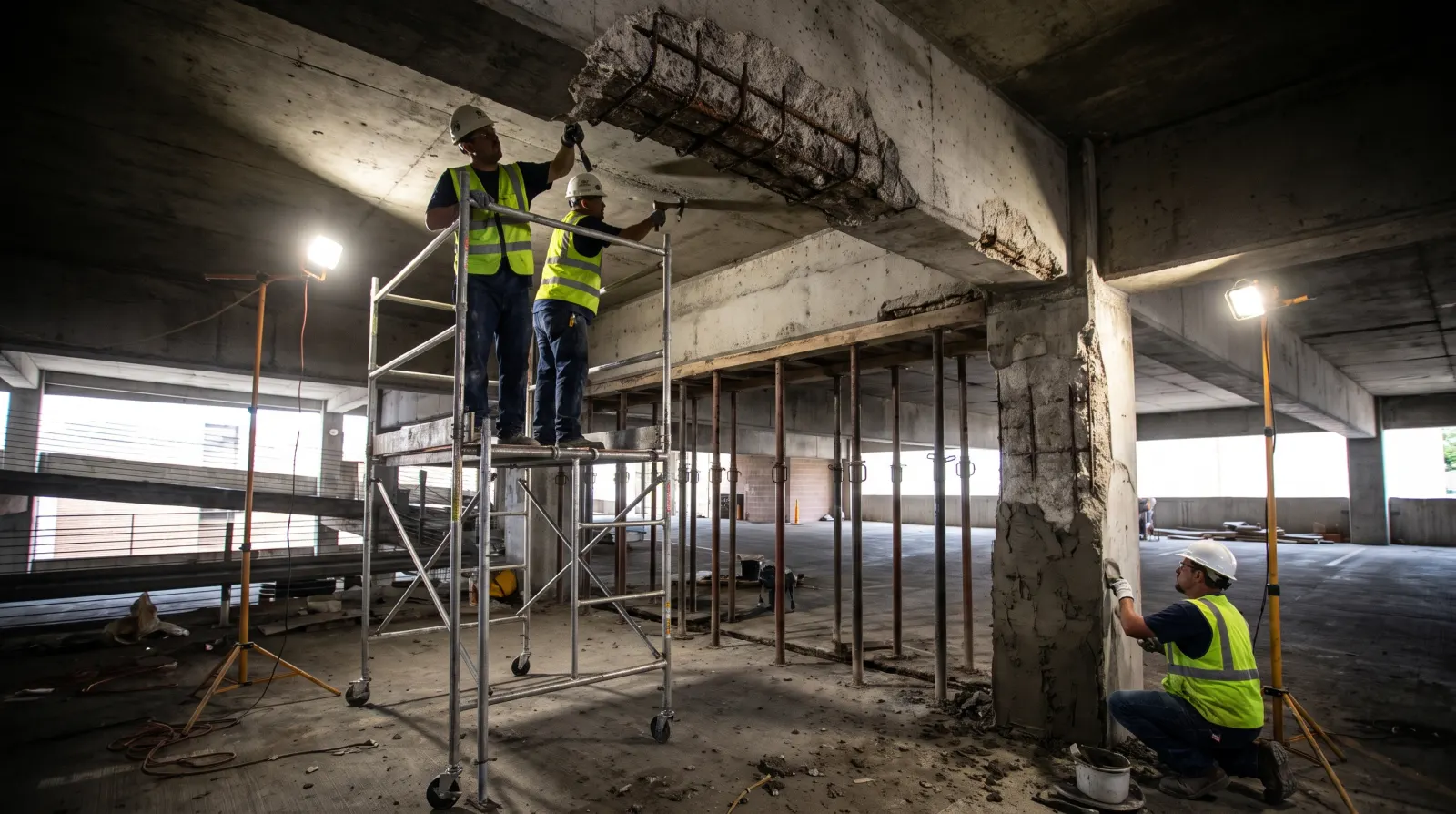
A parking structure is exposed like a bridge but detailed like a building. Cars carry in rainwater, and near the coast the air and that water are loaded with salt. Water ponds in low spots, soaks into the wearing surface and runs through cracks and failed joints to the level below. Chlorides collect at the top mat of reinforcing, at beam and column connections and around drains, and the steel corrodes long before the surface looks damaged.
Plaza decks add a second problem: the membrane is buried under pavers, planters or topping slabs, so a leak can run for years unseen. Expansion joints move with every temperature swing and are usually the first component to fail. In precast garages the joints between double tees and the connections at their bearing ends take the same exposure. Dripping water, white deposits on ceilings and rust stains on the underside are the signs that a deck is no longer shedding water.
What is included
Parking Garage Restoration: scope of work
- 01Slab, beam, column and double-tee repair
- 02Overhead and vertical concrete repair
- 03Expansion joint replacement
- 04Vehicular and pedestrian traffic deck coatings
- 05Plaza deck waterproofing under pavers and planters
- 06Drainage correction, striping and signage restoration
How we do it
How deck repairs and traffic coatings are sequenced
The engineer's survey usually combines chain dragging of the top surface with a visual review of the soffits, beams and columns. We mark the delaminations, agree quantities and set the phasing with management so drive aisles and exits stay open. Shoring is placed under any bay where slab or beam repairs reduce capacity. Work zones are barricaded, and dust and slurry are contained so they do not reach parked vehicles or storm drains.
Concrete repairs come first. Top-surface delaminations are sawcut, removed to sound concrete and below the bar where it is corroded, cleaned and repoured, full depth where damage goes through the slab. Overhead and vertical repairs on soffits, beams and columns are formed and poured or hand-applied to the engineer's detail. Cracks are routed and sealed, drains are cleared or added where ponding occurs, and expansion joint blockouts are rebuilt so the new seal has sound edges to bond to.
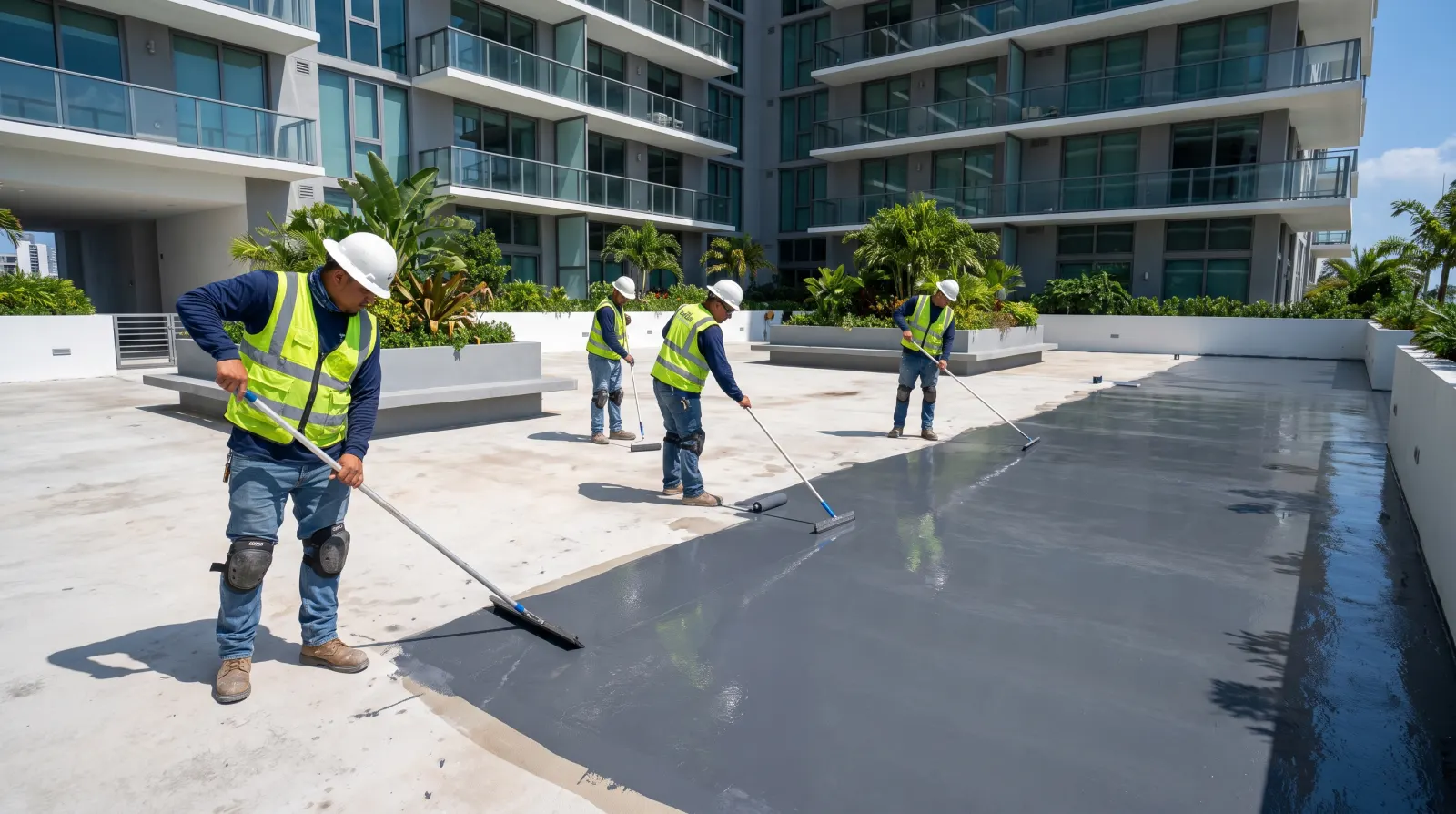
Protection follows. The deck is shot blasted or otherwise profiled as the coating manufacturer requires, and moisture and cure time are checked before the system goes down. A vehicular traffic coating is built in layers: primer, a flexible base membrane, then aggregate-filled wear coats, with heavier builds at ramps and turns. New expansion joint seals are installed, lines are restriped, and each area reopens to cars only after the cure time on the data sheet has passed.
Materials and systems
Traffic coatings, joint systems and corrosion protection for parking decks
Vehicular traffic coatings are multi-layer membranes, and the chemistry is chosen for the deck. Polyurethane systems are the long-standing standard: a flexible base coat that bridges cracks, topped by wear coats loaded with aggregate. PMMA and polyurea-type systems cure much faster, which shortens closures on ramps and entrances, and some hybrid systems add an epoxy wear layer for abrasion resistance in turning lanes. Where a membrane is not specified, a penetrating silane sealer reduces water and chloride absorption but does not bridge cracks or stop a leak.
Expansion joints in a garage are selected for the movement the engineer calculates and the traffic they carry. Options include pre-compressed foam seals, extruded rubber glands set in a blockout with elastomeric concrete nosings, and winged seals bonded into the deck membrane. Routed cracks and control joints receive traffic-grade polyurethane or silicone sealant. For corrosion control, the engineer may specify embedded galvanic anodes in patches, surface-applied inhibitors or, in heavily contaminated decks, an impressed current cathodic protection system.
What makes it last
What makes parking deck repairs and coatings last
Traffic coatings fail early for a short list of reasons: the deck was not profiled, the concrete was too damp, repair mortars had not cured, or the wear coat was applied too thin in the lanes that take the most turning. A durable installation starts with shot blasting to the surface profile on the data sheet, moisture testing, and detail work at cracks, drains and column bases before the field coats go down. Drainage deserves equal attention, because ponded water finds every pinhole in a membrane.
A parking garage restoration proposal should show the phasing plan level by level, the number of spaces out of service in each phase, and the shoring that will be in place under repair bays. Ask for the coating system by name with its build in each traffic zone, and the cure time before cars return. During the work, expect adhesion tests or a mock-up area, thickness checks and engineer inspection of exposed steel. Manufacturers issue coating warranties under their own terms.
How a project runs
Planned around the people who use the building.
- 01
Walk the property
We start on site with your manager, board or engineer and look at the conditions first-hand.
- 02
Define the scope
You get a written scope tied to the engineer's report or our findings, with the phasing spelled out.
- 03
Plan access and safety
Swing stages, shoring, barricades, parking and resident notices are set before the first cut.
- 04
Do the work
Our crews carry out the repairs in sequence, with inspections at the points the engineer requires.
- 05
Close it out
Final inspections, permit closure and a record of what was done, for the association's files.
Where we do it
Parking Garage Restoration by county
Summary
Parking Garage Restoration: key takeaways
- 01
A traffic coating is a system of primer, flexible membrane and aggregate-filled wear coats, built heavier on ramps, turns and drive aisles.
- 02
Penetrating sealers slow chloride absorption into a parking deck but cannot bridge a crack or stop an active leak.
- 03
Expansion joints are the most frequent leak path in a garage and are sized by the engineer for calculated movement.
- 04
Shot blasting, moisture testing and full cure of repair mortars come before any deck membrane is applied.
Glossary
Terms you will see in the engineer's report
- Double tee
- A precast concrete floor member shaped like two letter T forms side by side. The joints between double tees must be sealed.
- Traffic coating
- A liquid-applied waterproof membrane with aggregate broadcast into its upper layers so that it resists tire wear while keeping water and salt out of the slab.
- Chain drag
- A survey in which a length of chain is pulled across a deck. A dull sound instead of a clear ring marks delaminated concrete.
- Blockout
- A recess formed or cut into the slab on each side of an expansion joint to receive the joint system and its nosing material.
- Cathodic protection
- A corrosion control method that makes the reinforcing steel the protected side of an electrical circuit, using sacrificial anodes or a powered system.
Questions
Parking Garage Restoration: common questions
Can the garage stay open during repairs?
Usually. We phase the work by level or by bay and keep traffic moving around the work zone. Shoring, barricades and a parking plan are agreed with management before any area is closed.
How often does a garage traffic coating need to be redone?
It depends on traffic, exposure and the system installed. The wear coat thins first in drive lanes, turns and ramps, and those areas can often be recoated without replacing the whole membrane. Regular inspection matters more than a fixed interval: once the membrane is worn through, water and salt are back in the slab.
What is the white staining on our garage ceiling?
It is usually efflorescence. Water passing through the slab dissolves minerals from the concrete and deposits them where it drips out and evaporates. The staining itself is not structural, but it shows that water is travelling through a crack or joint, and the drips can mark vehicle paint. The source should be traced and sealed.
Does a parking garage need a traffic coating on every level?
Not always. Engineers commonly specify a full membrane on levels over occupied space, on the exposed roof level and on entry lanes where cars carry in water. Slabs on grade usually do not receive one. Intermediate supported levels may get a membrane or a penetrating sealer depending on their condition, chloride content and the owner's plan. The specification governs.
What is post-tensioned concrete, and does it change how a garage is repaired?
Post-tensioned slabs are reinforced with high-strength steel tendons that are stressed after the concrete hardens. Cutting or chipping near a tendon or its anchorage without a plan can release that force suddenly. Repairs on a post-tensioned deck therefore begin with locating the tendons, and any work on them is designed by the engineer.
Can residents stay in the building during restoration?
In most projects, yes. Work is phased by elevation or stack, balconies are closed only while they are under repair, and notices go out before anything affects residents. We agree the sequence and access plan with the board and manager before work starts.
Do you work with our engineer?
Yes. Structural repairs are built to the specification of your engineer of record, and we coordinate inspections with them throughout the job. If you do not have an engineer yet, we can help you get started.
Standards and references
- International Concrete Repair Institute (ICRI): concrete repair guidelines
- American Concrete Institute (ACI): codes and guides for concrete construction and repair
- Florida Building Code
Repair methods and materials on every project follow the engineer's specification, the manufacturer's requirements and the building code in force. This page is general information, not engineering advice.
Related services
Referred by an engineer?
Have drawings, specifications or a full set of bid documents?
Most of our restoration, pool and roofing work comes to us through structural engineers, property engineers and board members. When the scope is already drawn and specified, we price exactly what is on the documents, flag anything that needs a question, and show every line so the board can compare bids fairly.
Request an estimate
Let's look at your building.
Send us the engineer's report, a few photos or a short description. We will schedule a site visit and follow up with a written scope.
- 45 years in the business
- Broward and Palm Beach counties
- Reply within one business day
Prefer to talk?(561) 678-4182
We reply within one business day. Your details are only used to respond to this request.