Concrete Restoration
Concrete Restoration & Structural Repair
Spalling, cracking and corroded rebar, repaired to the engineer's specification.
In short
What is concrete restoration?
Concrete restoration is the repair of reinforced concrete that has cracked, delaminated or spalled, usually because the steel inside it is corroding. The work removes the damaged material, treats or replaces the reinforcing and rebuilds the section. A building needs it when an engineer finds hollow-sounding areas, exposed or rusting bar, or loose concrete on slabs, beams, columns or walls.
Concrete Restoration
Salt air drives chlorides into concrete until the reinforcing steel rusts, swells and breaks the slab apart from the inside. We remove the damaged concrete, clean or replace the steel, protect it against future corrosion and rebuild the section so it carries load the way it was designed to.
Unified GCS has spent 45 years in this business. We carry out concrete restoration projects across Broward and Palm Beach counties for condominium associations, property managers, commercial owners and industrial operators.
Written and reviewed by the Unified GCS project team, 45 years in concrete restoration and construction. Last reviewed October 2026.
Why it happens
Why reinforced concrete breaks down in South Florida
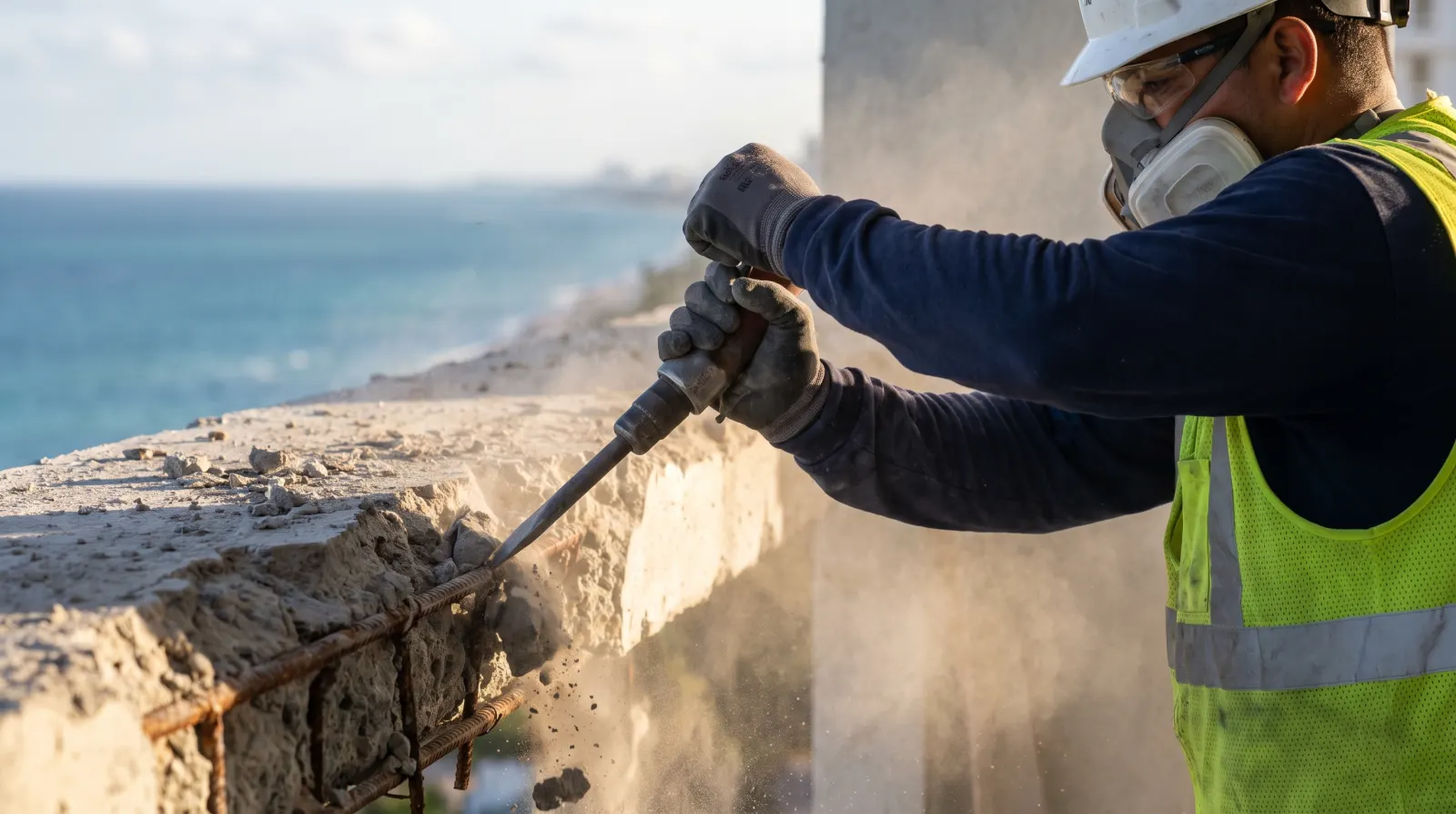
Concrete protects reinforcing steel in two ways: it keeps water and oxygen away from the bar, and its high alkalinity forms a passive film on the steel surface. Chloride intrusion breaks that film. Salt carried in ocean air settles on the surface, dissolves in rain and dew, and migrates inward through pores and cracks. Once enough chloride reaches the bar, corrosion starts even though the concrete around it still looks sound from the outside.
Carbonation works more slowly toward the same result. Carbon dioxide in the air reacts with the cement paste and lowers its alkalinity, and where cover over the steel is thin the carbonated zone can reach the bar within the life of the building. Rust occupies several times the volume of the steel it replaces. That expansion causes delamination, a crack plane parallel to the surface, and eventually a spall. Each crack gives water and salt a shorter path, so the damage accelerates.
What is included
Concrete Restoration: scope of work
- 01Spall and delamination repair on slabs, beams, columns and walls
- 02Rebar cleaning, coating, splicing and replacement
- 03Structural crack repair and epoxy injection
- 04Form-and-pour, hand-applied and overhead repair mortars
- 05Shoring and temporary support during repairs
- 06Corrosion inhibitors, sealers and protective coatings
How we do it
How a spall repair is carried out, step by step
The work begins with sounding. A hammer or chain dragged over the surface gives a dull, hollow note where the concrete has delaminated, and each area is marked and measured so the engineer can confirm quantities. Shoring is installed before any load-carrying member is opened. The repair area is then outlined with a shallow sawcut perimeter, which gives the patch a square shoulder instead of a thin feathered edge that would break away later.
Inside the sawcut, deteriorated concrete is chipped out with light hammers until sound material is reached. Good practice calls for undercutting the bar, clearing behind it so the new material surrounds the steel completely. The bar is cleaned to bright metal and the engineer checks it for section loss. Where too much steel is gone, new bar is lapped or spliced alongside. The exposed steel then receives the corrosion-inhibiting coating named in the specification, and sacrificial anodes are tied in where the engineer calls for them.
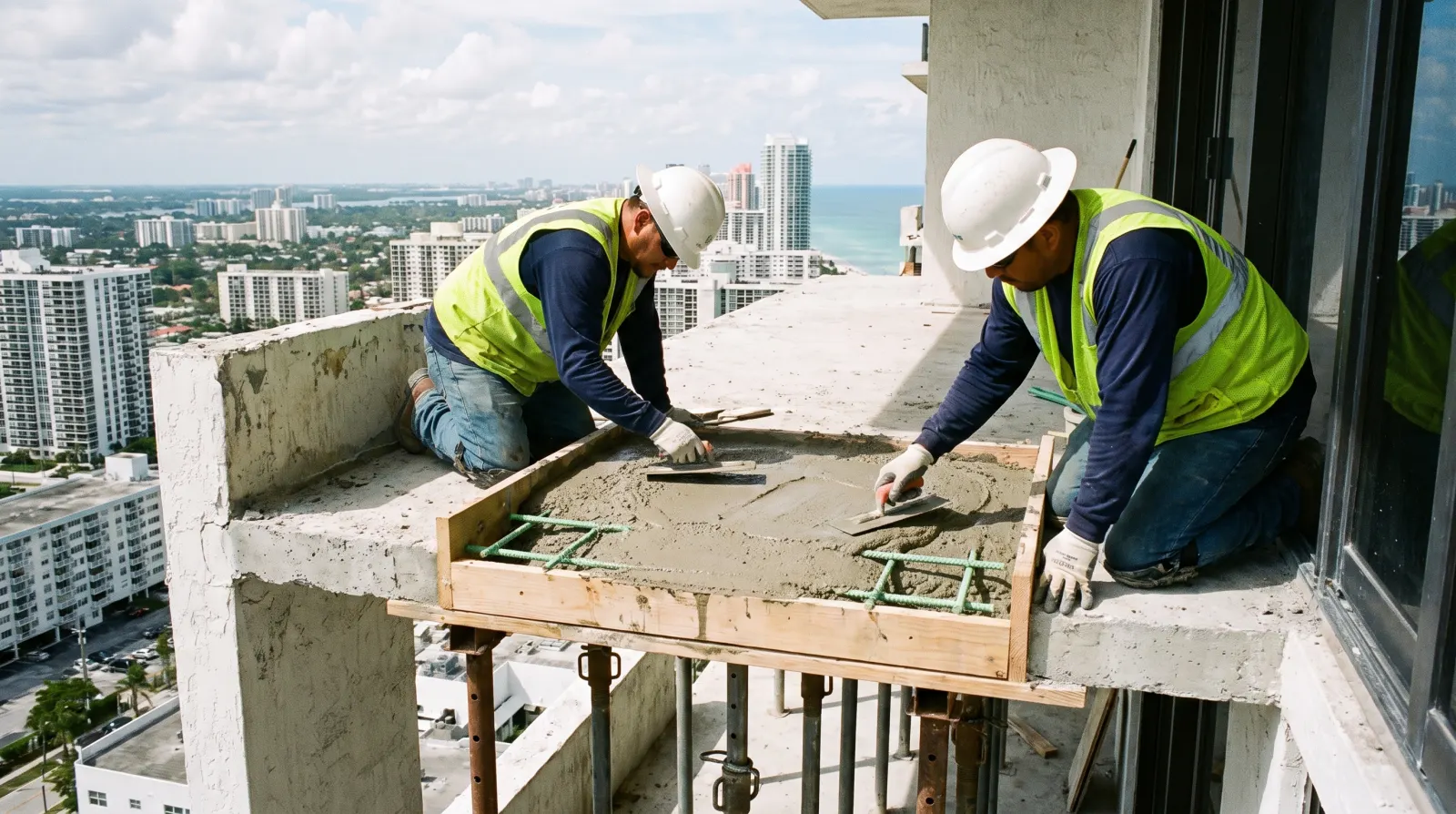
The prepared surface is cleaned, then dampened or primed with a bonding agent as the product data sheet requires, and rebuilt. Shallow vertical and overhead repairs are usually hand-applied in lifts with a polymer-modified mortar. Deeper or larger sections are formed and filled by the form-and-pour method so the material consolidates around the steel. The engineer typically inspects the exposed steel before placement. After the specified cure time, the patch is sounded again and protected with a sealer, coating or membrane.
Materials and systems
Repair mortars, form-and-pour mixes and corrosion protection: how the material is chosen
Repair materials for reinforced concrete fall into a few families. Polymer-modified cementitious mortars are trowel-applied in lifts and suit shallow vertical and overhead patches, where low weight and good adhesion matter. Flowable repair concretes, and mortars extended with pea gravel, are used for form-and-pour and form-and-pump placement in deeper sections. Each product has a minimum and maximum thickness per lift, stated on its data sheet, and using it outside that range is a common cause of cracking.
The engineer selects a repair material for its compatibility with the existing structure as much as for its strength. A patch that is far stiffer than the surrounding concrete, or that shrinks as it dries, tends to crack or debond at the perimeter. Low shrinkage, a similar stiffness and a similar rate of thermal expansion are the properties that matter. Corrosion protection is specified separately: bar coatings, embedded galvanic anodes at patch edges, migrating corrosion inhibitors, and silane sealers on the finished surface.
What makes it last
What separates a concrete repair that lasts from one that fails early
Most early repair failures trace back to preparation, not to the product. A durable patch has a sawcut edge, concrete removed to a sound substrate, steel cleaned all the way around, and a surface that is clean and saturated but free of standing water when mortar is placed. Bruised concrete left by heavy hammers, dust in the cavity or a feathered edge will show up as a hollow patch within a few years. Curing matters equally: a mortar that dries too fast in sun and wind shrinks and cracks.
A sound proposal for spall and crack repair names the products by manufacturer, references the engineer's details, and explains how quantities will be measured and verified. Boards should ask where the hold points are, meaning the stages at which work stops until the engineer has inspected exposed steel or a prepared cavity. During the work, look for marked and numbered repair locations, photographs of each one before it is closed, and sounding of finished patches. Material warranties are issued by the manufacturer under its own terms.
How a project runs
Planned around the people who use the building.
- 01
Walk the property
We start on site with your manager, board or engineer and look at the conditions first-hand.
- 02
Define the scope
You get a written scope tied to the engineer's report or our findings, with the phasing spelled out.
- 03
Plan access and safety
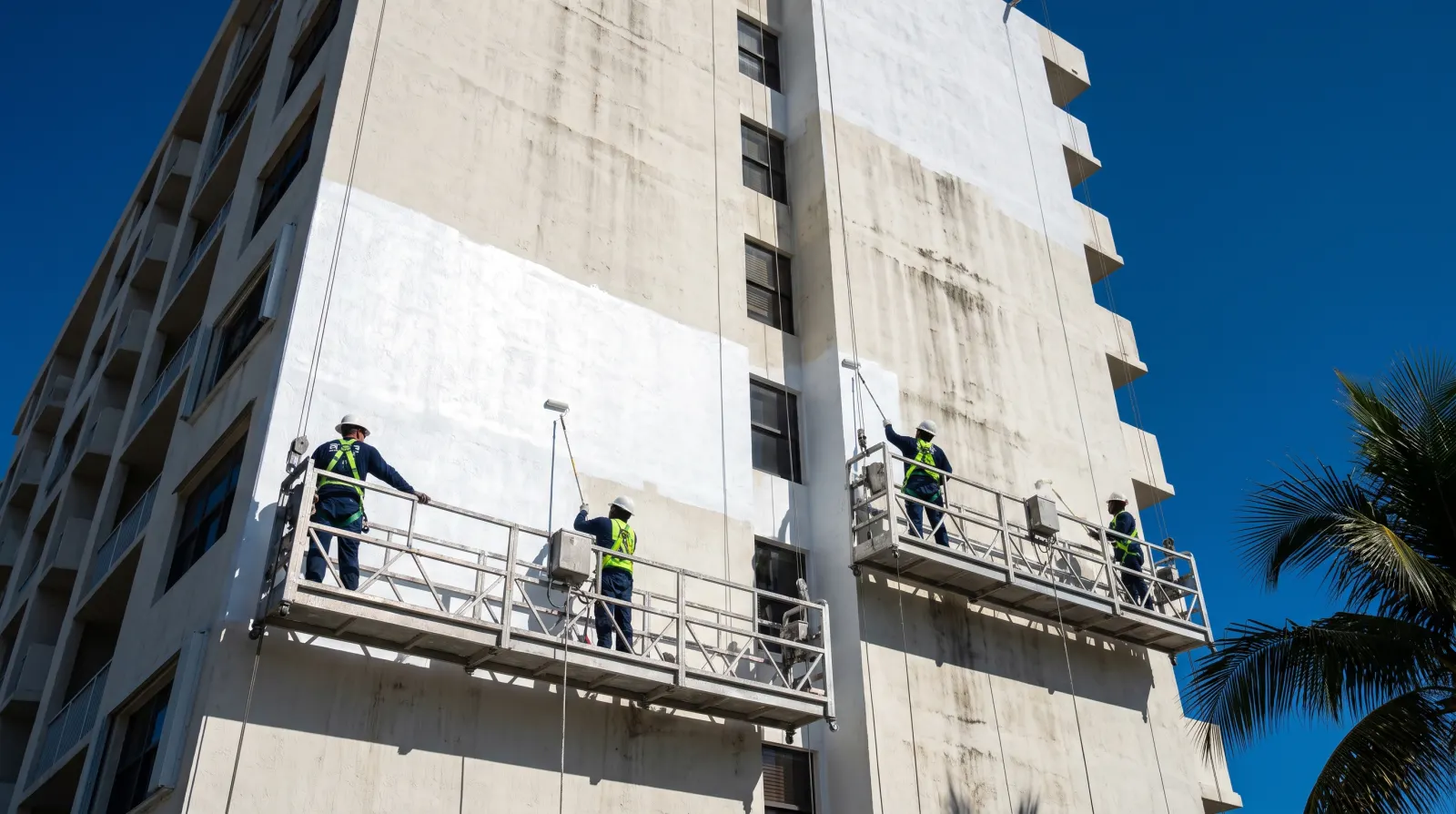
Swing stages, shoring, barricades, parking and resident notices are set before the first cut.
- 04
Do the work
Our crews carry out the repairs in sequence, with inspections at the points the engineer requires.
- 05
Close it out
Final inspections, permit closure and a record of what was done, for the association's files.
Summary
Concrete Restoration: key takeaways
- 01
Concrete restoration succeeds or fails on surface preparation, well before any repair mortar is mixed.
- 02
The engineer of record chooses repair materials for compatibility with the existing concrete, not for the highest strength on the data sheet.
- 03
Embedded galvanic anodes and surface sealers slow new corrosion at the edges of a patch, where chloride-contaminated concrete remains.
- 04
Numbered repair locations, photographs and engineer hold points give an association a verifiable record of what was repaired.
Glossary
Terms you will see in the engineer's report
- Delamination
- A separation inside the concrete, roughly parallel to the surface, usually caused by corroding steel. Delaminated concrete sounds hollow when tapped.
- Section loss
- The amount of steel a reinforcing bar has lost to rust. The engineer uses section loss to decide whether a bar must be supplemented.
- Galvanic anode
- A small zinc unit tied to the reinforcing inside a repair. The zinc corrodes in place of the steel, which protects the bar around the patch perimeter.
- Concrete cover
- The thickness of concrete between the surface and the nearest reinforcing bar. Thin cover lets salt and carbonation reach the steel sooner.
- Halo effect
- New corrosion that begins in old concrete just outside a fresh patch, because repaired and unrepaired steel now sit in different conditions.
Questions
Concrete Restoration: common questions
What causes concrete to spall in South Florida?
Salt-laden air and moisture work their way through the concrete to the reinforcing steel. As the steel rusts it expands to several times its original size, and that pressure cracks the concrete around it and pushes it off. The closer a building is to the ocean, the faster it happens.
Do you work from an engineer's repair drawings?
Yes. Structural repairs are built to the specification of the engineer of record. If your association does not have an engineer yet, we can point you in the right direction and coordinate the scope with them.
How long does a concrete repair last?
A repair that is properly prepared, bonded and protected can last for decades, but its life depends on what happens around it. If water keeps reaching the slab, or chloride-contaminated concrete remains beside the patch, corrosion can restart at the edge. Keeping water off the surface and maintaining sealants and coatings are what protect the repair over time.
When can a crack be injected instead of cut out and repaired?
A crack caused by shrinkage or a one-time movement, with sound concrete on both sides, can often be sealed or structurally bonded by epoxy injection. A crack that runs along a reinforcing bar usually means the steel is corroding beneath it, and injection will not stop that. The engineer decides which method applies at each location.
What is the difference between a structural and a cosmetic concrete repair?
A structural repair restores a member that carries load, such as a slab, beam or column, and involves the reinforcing steel. It follows an engineer's detail and is permitted and inspected as the building official requires. A cosmetic repair addresses surface defects that do not affect capacity. The engineer makes that distinction, not the contractor.
Why do new cracks sometimes appear next to an old concrete patch?
Concrete beside a patch often still contains chlorides. Once the repaired area is filled with fresh, alkaline mortar, the steel just outside it can become the new active corrosion site, which engineers call the halo effect. Removing concrete to beyond the corroded length of bar and installing galvanic anodes at the perimeter are the usual defenses.
Can residents stay in the building during restoration?
In most projects, yes. Work is phased by elevation or stack, balconies are closed only while they are under repair, and notices go out before anything affects residents. We agree the sequence and access plan with the board and manager before work starts.
Do you work with our engineer?
Yes. Structural repairs are built to the specification of your engineer of record, and we coordinate inspections with them throughout the job. If you do not have an engineer yet, we can help you get started.
Standards and references
- International Concrete Repair Institute (ICRI): concrete repair guidelines
- American Concrete Institute (ACI): codes and guides for concrete construction and repair
- Florida Building Code
Repair methods and materials on every project follow the engineer's specification, the manufacturer's requirements and the building code in force. This page is general information, not engineering advice.
Related services
Referred by an engineer?
Have drawings, specifications or a full set of bid documents?
Most of our restoration, pool and roofing work comes to us through structural engineers, property engineers and board members. When the scope is already drawn and specified, we price exactly what is on the documents, flag anything that needs a question, and show every line so the board can compare bids fairly.
Request an estimate
Let's look at your building.
Send us the engineer's report, a few photos or a short description. We will schedule a site visit and follow up with a written scope.
- 45 years in the business
- Broward and Palm Beach counties
- Reply within one business day
Prefer to talk?(561) 678-4182
We reply within one business day. Your details are only used to respond to this request.